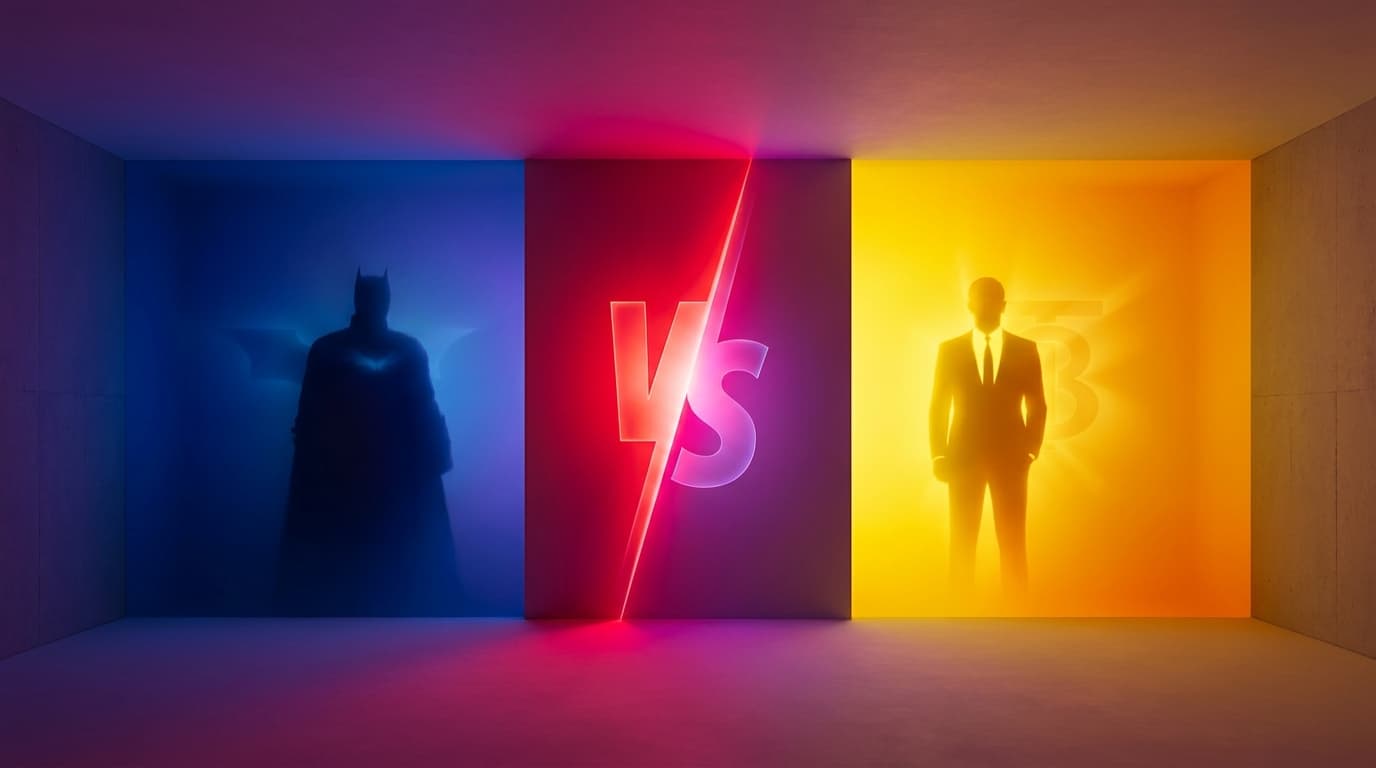
Batman vs. The Billionaire: The Two Faces of Political Media in 2026
 Priyanka
Spectacle vs. stakes -- and why one of these videos created a meme, while the other created a problem on CNBC.
On April 15, 2026 -- Tax Day -- New York City Mayor Zohran Mamdani stood on the sidewalk outside 220 Central Park South, pointed up at a $238 million penthouse, and said, "Today we're taxing the rich." The video was 68 seconds long. It was shot on a phone. There were no graphics, no score, no B-roll, no AI. It looked like something a tourist would film. Within ten days, it had cleared 700,000 views on the Mayor's Office YouTube channel alone, Fortune and Bloomberg had filed, Citadel had publicly called the mayor "shameful", and Ken Griffin had gone on CNBC to accuse Mamdani of putting him "in harm's way" -- and to announce that Citadel was doubling down on Miami in response. A 68-second phone video had become a multi-week news cycle and a real estate decision worth a multibillion-dollar tower.
Three thousand miles west, a different kind of political video was going viral. Spencer Pratt, the reality-TV personality turned Republican candidate for mayor of Los Angeles, reposted a 90-second cinematic AI ad that recast L.A. as Gotham: the Hollywood sign in flames, City Hall burning, Karen Bass as the Joker, Gavin Newsom eating cake like a deposed French aristocrat, and Pratt himself descending into the city as Batman. The ad wasn't made by Pratt's campaign. It wasn't made by any campaign. It was produced by filmmaker Charles Curran of Menace Studios, an L.A.-based creator with no formal political role, who simply made the thing and put it online. Pratt reposted it. Jeb Bush called it "maybe the best political ad of the year." Ted Cruz and Matt Gaetz shared it. Within days, it had millions of impressions and wall-to-wall coverage in CBS, NBC, The Hollywood Reporter, and Rolling Stone.
Both videos went massively viral. Both were defining moments of a strange new year in American political media. But only one of them had a billionaire complaining about it on cable television. Only one of them moved a $65-billion hedge fund's expansion plans. Only one of them turned an obscure tax proposal -- Governor Kathy Hochul's pied-à-terre surcharge -- into a national debate about whether New York would still be New York.
That asymmetry is the story.
The easy frame for this moment -- AI is taking over campaigns -- misses what's actually happening. The deeper split in 2026 isn't between politicians who use AI and politicians who don't. It's between two competing theories of what a political video is for. One theory says the goal is symbolic compression: maximum emotional voltage, maximum shareability, maximum algorithmic legibility -- a meme dense enough to carry an entire worldview in 90 seconds. The other theory says the goal is embodiment: proof that a candidate showed up, in a specific place, and confronted a specific person, and that you can see it happen with your own eyes. Spectacle versus stakes. Synthetic Gotham versus a real sidewalk on Central Park South.
The first theory is currently winning the impressions war. The second is winning everything that comes after impressions.
The 30-second spot is dead. The clip is the new unit.
The TV ad as a sealed object -- written, produced, approved, aired, ended -- barely exists anymore as the unit of political persuasion. The unit now is the clip: vertical, sub-90-seconds, native to whichever platform it dies on, designed to be re-cut by enemies and allies alike. The campaign ad has merged with the meme. The campaign ad has merged with the governing act. And -- most importantly -- the campaign ad has merged with fan content. The Curran video is the cleanest case study of the era: a piece of political media that may end up defining a major mayoral race, made by a private filmmaker with no campaign role, distributed by the candidate after the fact. The campaign no longer controls its own ads. It can only retweet them.
Mamdani's video is the symmetrical mutation on the other end. It isn't really an "ad" in the traditional sense. It's a governing act filmed as if it were one. Standing on a sidewalk in front of a specific billionaire's specific penthouse is a policy announcement, a campaign promise, a personal threat, and a TikTok all at once. The video is the tax proposal. The location is the argument. There is no separation between communications and policy anymore -- they are the same surface.
Path one: AI spectacle
A new genre of cinematic AI political video has emerged in the last twelve months, and it has a recognizable grammar. Apocalyptic skies. Burning landmarks. Enemy archetypes -- Joker, aristocrat, demon. Savior mythology. A monochrome color palette designed to look like a Christopher Nolan reshoot. Each frame is a screenshot. Each screenshot is a meme. The point isn't to argue. The point is to compress an entire worldview into ninety seconds of pure emotional voltage.
The Pratt-as-Batman ad is the genre's masterpiece so far. *The Spectator* -- covering it admiringly -- captured the form clearly: Curran's video "shows Pratt being called on to save a dystopian LA from the Democratic establishment," with the radio host Buck Sexton hailing it as "the future of political communication." But the genre didn't start with Pratt. It started, more soberly, in October 2025, when the National Republican Senatorial Committee posted an AI deepfake of Chuck Schumer appearing to celebrate the government shutdown. The quote was real -- pulled from a print interview -- but the moving-image Schumer was synthetic. NPR called it a video that "crosses a new boundary in politics." Five months later, the same committee released an AI deepfake of Texas Senate candidate James Talarico, reading aloud his own old tweets with a hollow reverb voice mocking him in the background. The Bulwark called it "AI psyops."
The pattern is now stable enough to name. The grammar of right-coded AI political video in 2026 is dystopia, superhero mythology, civilization-at-stake symbolism, and enemy archetypes -- combined with an aesthetic willingness to look unembarrassed at being lurid. The right gets to AI faster than the left in part because the right's online culture has always rewarded maximalism, low-status meme density, and trollish provocation. AI rewards exactly those traits. It is the perfect engine for an aesthetic that already prized synthetic intensity over documentary realism.
This is where it's tempting to write that AI is right-wing coded. It isn't. The technology is neutral. Texas Democrat Jasmine Crockett has used AI in primary advertising. Progressive PACs have experimented with AI-generated supporters in field videos. The tools are bipartisan. What's coded right, at this moment, is a specific aesthetic vocabulary -- apocalypse, savior, enemy, spectacle -- that maps more naturally onto the populist right's existing internet style than onto the documentary moralism the left has spent fifteen years building since Occupy. That gap may not last. But right now, when you see a political ad that looks like it cost a million dollars and was made in a weekend on a single workstation, you can usually guess which party paid for it.
Path two: IRL embodiment
The counter-aesthetic is older, cheaper, and -- in a strange way -- more radical. It is just a person standing somewhere, on a phone, talking. Its claim to power is not that it looks expensive. Its claim is that it happened. The candidate's body was in that location. The billionaire's address is that address. The tax is real. You can walk to the building.
The Mamdani video works because every element of it is non-negotiable. The location is 220 Central Park South. The penthouse is Griffin's. The proposal is Hochul's pied-à-terre tax, which would apply a yearly surcharge to non-primary residences valued over $5 million. The mayor said the thing he ran on saying, on the day taxes are due, in front of the building that most embodies the policy. There is no symbolic compression here. There is only address.
Compare this to the Pratt ad's relationship to evidence. Karen Bass is not actually the Joker. Gavin Newsom does not actually eat cake. Los Angeles is not actually on fire. The ad is a feeling rendered as a film. The Mamdani video is the inverse: a policy rendered as a location. Both go viral. Only one of them can be checked against reality with your own eyes.
This is the format that has carried most of the left-coded insurgent viral wins of the last several years -- AOC livestreaming from her car at the southern border, Bernie Sanders standing on UAW picket lines, organizers filming themselves outside ICE facilities. The grammar is: address as argument, cheap production as credibility, class geography made physically legible, the candidate's body as the source of authority. The antagonist is identifiable, addressable, and -- crucially -- able to respond. Which is exactly the problem, if you are the antagonist.
Two coasts, two theories
It is not an accident that these two videos came out of New York and Los Angeles in the same month. The cities have always exported their media DNA, and 2026 is no exception. New York, the home of the tabloid front page and the public-sidewalk press conference, produced a video that is essentially a front page made flesh: a real building, a real billionaire, a real policy, on a real street, in 68 seconds. Los Angeles, the home of cinematic universe-building and synthetic spectacle, produced a video that is essentially a movie trailer: a fictional Gotham, a fictional Joker, a fictional aristocrat, in 90 seconds of color-graded apocalypse. The Mamdani video is a piece of New York. The Pratt ad is a piece of Los Angeles. Each city is doing what it has always done -- and in 2026, those two civic temperaments are producing the two dominant grammars of American political media.
The impression numbers tell the same story from the other direction. The Pratt ad cleared millions of views in its first week through conservative-media amplification -- NBC, CBS, *The Hollywood Reporter*, *Rolling Stone*, the full Cruz-Gaetz-Sexton podcast circuit. The Mamdani video did roughly 700,000 views on the official Mayor's Office YouTube channel alone, plus uncounted millions more across TikTok, X, and Instagram reposts. On raw circulation, L.A. won the week. On consequence, New York won the month: a tax fight, a CNBC interview, a Citadel relocation, a billionaire coalition response, a citywide argument that is still going. If you ask which video was more effective, the question only has an answer once you decide what effective means. The Pratt ad was more effective at being seen. The Mamdani video was more effective at being answered.
The algorithm doesn't care which you pick
Both formats succeed on the same platform logic -- vertical, sub-90-seconds, optimized for conflict-in-one-second-of-thumbnail -- and both deliver, in different shapes. AI wins the first 48 hours: novelty, intensity, meme density, the irresistible weirdness of seeing Karen Bass made up like Heath Ledger. IRL wins the long tail: earned media, antagonist response, narrative recurrence, the second story and the third story and the fourth.
The Pratt ad generated millions of impressions in the first week, a chorus of validators from Jeb Bush to Ted Cruz to Matt Gaetz, and a genuine national debate about whether AI was now the future of political communication. By raw volume, it almost certainly won the week of May 5. But the curve flattened fast. There was no sequel. No L.A. official came out to denounce it on cable. Karen Bass did not change her schedule. Newsom did not relocate the state government. The video was the event. The event ended when the impressions did.
The Mamdani video has the opposite shape. It started slower -- 700,000 YouTube views is a strong number, but it isn't viral by 2026 standards. What turned it into a multi-week story was that the antagonist couldn't help himself. Griffin called Citadel's lawyers. Citadel issued a statement calling the mayor "shameful." Griffin then went on CNBC and said the mayor had "put me in harm's way," invoking the 2024 assassination of UnitedHealthcare CEO Brian Thompson. He announced Citadel was filing permits in Miami, expanding the headquarters there, and threatening to walk away from a New York development that would have created 15,000 jobs. *New York Magazine* ran the headline "Ken Griffin Is Mightily Pissed Off With Zohran Mamdani." *Fast Company* ran the harm's-way quote in its headline. Every escalation was downstream of one 68-second phone video.
This is the part that matters: the Mamdani video kept getting more powerful as time passed. The Pratt ad kept getting less powerful. AI ads compress; IRL videos compound.
Impressions are not persuasion
The sharpest distinction the 2026 cycle is forcing into view is the one between circulation and consequence. They are not the same metric. They are barely even adjacent metrics.
Circulation is what the algorithm rewards: how many people saw the thing, how many people shared it, how many people made a remix, how many podcasters quoted it. By circulation, AI spectacle is winning in 2026 the way maximalist content has always won on the internet -- by being louder, shinier, and more emotionally extreme than its alternatives. Curran's video is a perfect specimen.
Consequence is what governance rewards: how many people changed their behavior, how many institutions had to respond, how many policies moved, how many opponents had to put out a statement. By consequence, IRL embodiment is winning, and it isn't close. The Mamdani video produced a tax debate, a billionaire backlash, a Citadel relocation announcement, a CNBC interview, a coordinated billionaire response strategy, and a citywide argument about whether New York welcomes the rich. The Pratt video produced impressions.
The cleanest way to say it: AI may be better at manufacturing impressions, but IRL video is better at manufacturing belief. The first one ends when the clip ends. The second one keeps generating sequels for as long as the antagonist keeps reacting.
Campaigns have not yet caught up to this distinction. Most are still optimizing for the first metric because the first metric is easier to measure, easier to demo to a donor, easier to put in a deck. But the campaigns that win in 2026 are likely to be the ones that figure out which metric they're actually trying to move, and stop confusing the two.
The ad has become the act
The deepest shift in 2026 isn't aesthetic. It's structural. The political ad has fully collapsed into political action.
Mamdani did not run a campaign ad about taxing the rich. He went to a billionaire's house and announced the tax. The video isn't promoting the policy -- it is the policy's launch event. The location isn't a backdrop -- it's the argument. The candidate isn't an actor -- he's the mayor, doing the job, on camera, in real time. There is no longer any meaningful separation between governing and communicating. They are the same surface.
Curran did not work for Spencer Pratt. He made an ad anyway. He distributed it himself. Pratt's role was to retweet it. The most influential piece of media in the Los Angeles mayoral race may end up being one the candidate didn't commission, didn't approve, didn't pay for, and didn't appear in until an AI rendering put him there. The campaign isn't producing its own content anymore. It's curating what its supporters make and hoping the best one breaks through.
These are two endpoints of the same evolution. On one end, the candidate has become so embedded in his own ads that the ad is indistinguishable from the act of governing. On the other end, the candidate has become so peripheral to his own ads that strangers are making them without him. The thing they share is that the old container -- the sealed, campaign-controlled, thirty-second TV spot -- is gone, and what's replacing it is something messier, faster, and much harder to manage.
Spectacle vs. stakes
The temptation in writing about political media right now is to treat AI as the story. It isn't. AI is a tool. The story is what kind of media now feels true enough to share, and what kind of media has enough weight to produce a sequel.
Two videos. Both viral. Both defining. One produced a meme. One produced a problem. One ended when the impressions ended. The other is still generating headlines a month later because the antagonist won't shut up about it.
The future of political advertising in 2026 isn't a fight between AI and authenticity. It's a fight between attention and consequence. Between media designed to circulate and media designed to land. Between candidates who know how to manufacture a spike and candidates who know how to manufacture a sequel.
The campaigns that win this cycle will be the ones that can do both. The campaigns that lose will be the ones that confused the first thing for the second -- that mistook the size of the audience for the depth of the impression, that mistook the meme for the moment, that mistook Batman for the billionaire.
In 2026, the most powerful political ad isn't the one that goes viral.
It's the one that someone has to answer for on CNBC the next morning.