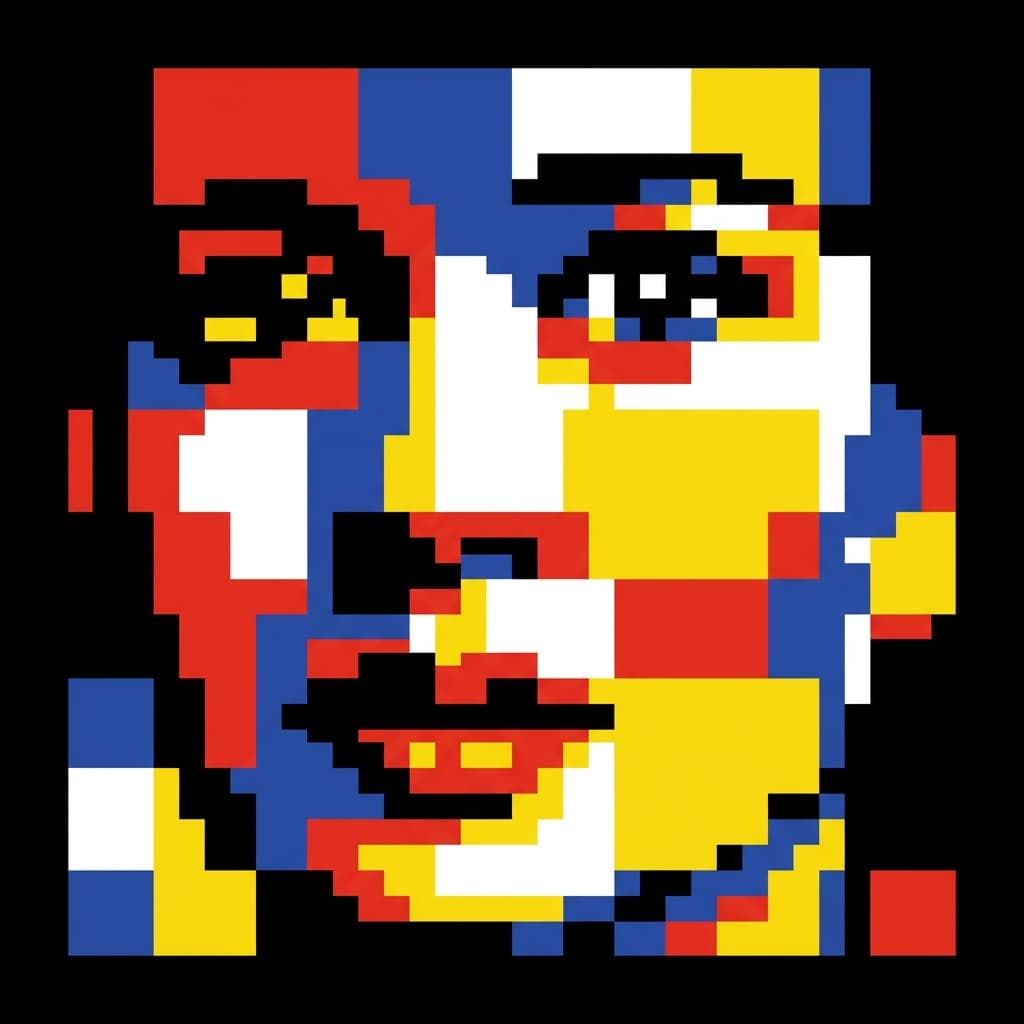
Digital Art Is the Art of Our Age
 Priyanka
Every era gets the medium it deserves. The Renaissance got oil painting -- a technology that let artists render flesh and light with new fidelity, built for a culture that worshipped the human body. The Industrial Revolution got photography. The 20th century got cinema. Each medium didn't just document its moment. It was made of the same stuff as its moment.
The 21st century gets digital art. Not because it's trendy. Because it's the only medium that operates the way our world actually works: networked, algorithmic, mutable, infinitely reproducible, and contested at every level -- who made it, who owns it, what it even is.
Why This Medium, Why Now
The case is structural, not aesthetic.
The forces shaping contemporary life are computation, networks, artificial intelligence, financialization, and the dissolving boundary between physical and virtual experience. Digital art doesn't depict these forces. It's made of them. A generative artwork runs on the same logic as the algorithms shaping your feed. An NFT sits inside the same financial infrastructure as decentralized markets. An AI artwork uses the same neural networks being deployed across labor, language, and warfare.
No canvas painting, no bronze, no photograph can say that. Those mediums can represent the digital age. Digital art is the digital age, compressed into aesthetic form.
What Makes It Structurally Different
Previous mediums each broke one or two rules. Photography broke the requirement of manual skill. Film broke the static image. Digital art breaks nearly everything at once.
Authorship is unstable. When an algorithm generates the work, when an AI hallucinates it, when a smart contract governs its behavior -- "who made this?" stops being a legal formality and becomes a real question.
The object is unstable. A digital artwork can change over time, respond to external data, evolve without the artist's intervention, or exist as pure code with no fixed visual form.
Scarcity is a design choice. A digital file copies infinitely. Blockchain reintroduces scarcity as a designed property -- artificial, transparent, programmable. This makes the economics of art visible in ways galleries spent centuries concealing.
Distribution is native. Digital art doesn't need a gallery or a publisher. It travels on the same networks as everything else. This reshapes who gets to make art, who sees it, and what "the art world" means.
The medium is the culture. Code carries the biases of its authors, the logic of its platforms, the politics of its infrastructure. Working with these materials means working with the raw stuff of contemporary power.
The Canon: Twelve Categories
What follows is a taxonomy of the major forms digital art has taken, from the earliest computer experiments to the present, and the artists in each most likely to be remembered.
1. Early Computer Art Pioneers (1960s-1980s)
Before anyone said "digital art," a handful of mathematicians and artists proved the computer was an aesthetic instrument. Mainframes, plotters, punch cards. The art world ignored them. History won't.
Vera Molnar started making algorithmic drawings in 1968. Randomness, repetition, variation, all generated through code. She spent decades in near-total obscurity. The institutions caught up to her in her late nineties.
Frieder Nake publicly exhibited computer-generated art in 1965 -- one of the first three people to do so. He also wrote the theory, giving the field its intellectual scaffolding before anyone else thought it needed one.
Harold Cohen) built AARON, an autonomous painting program, in the 1970s. A machine that made art before "AI art" was a phrase. Every conversation about machine creativity happening now, Cohen was having fifty years ago.
Lillian Schwartz worked at Bell Labs and pioneered computer animation and digital image processing. Her influence runs from Pixar to Processing.
Manfred Mohr translated multidimensional geometry into visual form through algorithms, and got it into galleries when the resistance was near-total.
Charles Csuri made plotter drawings in the 1960s that now sit in the permanent collections that define canons.
2. Net Art (1990s-2000s)
Art made of the browser, the protocol, the network. Not art distributed online -- art that couldn't exist without the internet as raw material.
JODI) (Joan Heemskerk and Dirk Paesmans) broke the browser open. Cascading green text, deconstructed websites, unusable interfaces. They turned the web's own infrastructure into sculpture.
Olia Lialina (@GIFmodel) made "My Boyfriend Came Back from the War" in 1996 -- hyperlinked narrative as emotional architecture. She also became the genre's best historian, preserving the early web through projects like "One Terabyte of Kilobyte Age."
Vuk Cosic helped coin the term net.art and understood early that the internet was a cultural medium, not a delivery system.
Heath Bunting brought net art into activist territory -- borders, identity systems, networked power. The political arm of the movement.
3. Post-Internet Art (2008-present)
Art made after the internet became ambient -- water you swim in, not a place you visit. These artists are fluent in network culture but not confined to a browser.
Hito Steyerl -- video installations and essays on image circulation, AI, surveillance capitalism, and the politics of visibility. "How Not to Be Seen" and "Duty Free Art" are already required material. She thinks about networks with more rigor than almost anyone working in any medium.
Cory Arcangel hacked Super Mario, made Photoshop gradient paintings. He treats the tools of digital culture as art materials with deadpan precision.
Jon Rafman documents the emotional texture of being online -- Google Street View as portraiture, deep-web aesthetics, the strange beauty hiding in overlooked corners of the network.
Petra Cortright treated YouTube and the webcam as painting surfaces. Vernacular internet as fine art material, without ironic distance.
Amalia Ulman performed "Excellences & Perfections" on Instagram in 2014 -- a scripted, months-long piece about class, femininity, and self-presentation on social media. One of the sharpest artworks about platform identity.
Ed Atkins makes CGI video about digital embodiment and the limits of rendered emotion. His avatars look almost real and feel deeply wrong -- which is the point.
Katja Novitskova turned the internet's visual unconscious -- stock imagery, scientific photography, algorithmic image selection -- into physical sculptures.
4. Generative and Code Art
The artist writes rules. The machine executes. The work lives in the gap between intention and emergence.
Casey Reas (@REAS) co-created Processing, the programming language that opened creative coding to artists and designers worldwide. Without it, the generative art ecosystem looks completely different.
Joshua Davis was making generative art in Flash before most people had heard the term. Pre-blockchain, pre-NFT. The OG.
Zach Lieberman (@zachlieberman) co-created openFrameworks, taught at the School for Poetic Computation, and built a global creative coding community through daily practice and radical openness. Artist, educator, and connective tissue.
Tyler Hobbs (@tylerxhobbs) made Fidenza -- flowing, organic compositions with a recognizable algorithmic signature. It proved that generative systems could produce work with real emotional weight, not just geometric novelty.
Dmitri Cherniak (@dmitricherniak) made Ringers -- pegs and string, encoded in an algorithm, producing infinite compositional variation. Simple rules generating inexhaustible beauty.
Matt DesLauriers (@mattdesl) pushes generative work toward the painterly -- soft, textured, atmospheric. His output suggests code can reach the warmth people associate with handmade media.
Robert Hodgin (@flight404) built particle systems and natural simulations that shaped what computational beauty looked like for a decade.
5. Crypto and NFT Art
Art native to the blockchain -- not "art sold as NFTs" but work shaped by on-chain logic, programmable ownership, and crypto culture.
Kevin McCoy minted Quantum) in 2014. The first NFT. He created the possibility of the entire category.
Beeple (@beeple) -- the $69 million Christie's sale forced the art market to confront digital art as a financial reality. His Everydays practice -- a new piece every day for over 5,000 consecutive days -- predates crypto and gives the position staying power beyond one auction result.
XCOPY (@XCOPYART) defined the visual language of crypto art. Glitch, death loops, skeletal figures, memetic dread. The aesthetic DNA of the entire NFT art movement runs through his work. He gave the culture its look.
Mitchell Chan (@mitchellfchan) made "Digital Zones of Immaterial Pictorial Sensibility" in 2017, reconstructing Yves Klein's 1959 conceptual experiment as an Ethereum smart contract. A direct bridge between postwar conceptual art and crypto-native practice, built years before the market went parabolic. Chan proved blockchain could carry genuine art-historical weight, not just speculation.
Snowfro (@ArtOnBlockchain) founded Art Blocks, the platform that made generative art collectible and verifiable on-chain. The platform itself functions as a creative act -- infrastructure that enabled an entire movement.
Matt Kane made "Right Place & Right Time," a painting whose colors shift dynamically based on Bitcoin's price. One of the first works to treat on-chain data as a live artistic input, not just a sales mechanism.
Sarah Zucker (@thesarahshow) works across analog and digital -- hand-drawn animation, VHS texture, crypto distribution. She bridges old craft and new infrastructure, and proves blockchain art doesn't have to look like blockchain.
Kim Asendorf (@kimasendorf) invented pixel sorting -- the technique that became the default glitch aesthetic across digital and crypto art. His SABOTAGE series continues to push algorithmic image manipulation forward.
Hackatao (@Hackatao) built a consistent mythological visual world across years of practice -- one of the few crypto artists constructing a universe rather than releasing drops.
6. AI Art
Art that uses machine learning and neural networks as core medium -- not just production tools but collaborators, subjects, or conceptual problems.
Refik Anadol brought machine learning visuals to institutional and public scale. His data sculptures have been acquired by MoMA and installed on buildings. The cultural reach is massive. Whether the work sustains critical interest over decades is the open question.
Mario Klingemann (@quasimondo) was making serious art with GANs before the current wave. "Memories of Passersby I" (2018) -- an autonomous system generating an infinite stream of faces -- was a landmark before generative AI became a consumer product.
Holly Herndon (@hollyherndon) and Mat Dryhurst (@matdryhurst) built "Holly+," an AI model of Herndon's voice that others can use. Their framework for AI authorship, consent, and artistic identity is the most serious thinking on how artists coexist with machine intelligence.
Robbie Barrat trained GANs on Old Master paintings as a teenager. His AI-generated nudes and landscapes are now considered early canonical works. Young enough and early enough to hold a permanent position.
Sofia Crespo (@soficrespo91) uses neural networks to generate imaginary biological forms -- artificial species, synthetic ecosystems. "Artificial Natural History" connects computation to the deep tradition of scientific illustration.
Trevor Paglen uses AI to interrogate surveillance, classification systems, and machine vision. Not decorative. Political. His work reveals what AI does to the world, not what it makes for us.
7. Digital Installation and Immersive Art
Art that fills rooms and public space using projection, sensors, data, and code.
teamLab (@teamLab) -- the most-visited art collective on the planet. Borderless redefined what a museum visit could be. They proved that accessibility and ambition aren't in tension.
Rafael Lozano-Hemmer (@erfrafa) builds interactive public installations using biometrics, surveillance technology, and crowd participation. The viewer's body becomes subject and material simultaneously.
Ryoji Ikeda strips data to pure light and sound -- massive projections of raw information, frequencies at the edge of perception. Computation with every decorative layer removed.
Random International made Rain Room -- a field of falling water that pauses wherever a body moves. Technology that responds to human presence, rendered as weather.
8. Game Art, Virtual Worlds, and Simulation
Game engines, virtual environments, and autonomous simulations as primary medium.
Ian Cheng made the "Emissaries" trilogy -- live simulations populated by AI agents that evolve without the artist's input. The work doesn't end. It keeps becoming.
Cao Fei built "RMB City" in Second Life and "Asia One" with industrial robots. Her work maps China's digital transformation with institutional seriousness.
LaTurbo Avedon (@laturboavedon) exists only as a virtual avatar. No confirmed physical identity. An artist who is, ontologically, their own medium.
Porpentine makes Twine-based hypertext games -- surreal, violent, tender, structurally inventive. She expanded what counts as a game and what counts as art at the same time.
9. Glitch Art
Art that exploits errors, corruptions, and system failures. The glitch reveals what the system was hiding.
Rosa Menkman (@rosamenkman) wrote the theory ("Glitch Moment/um"), makes the work, and built the community. The central figure.
Kim Asendorf (@kimasendorf) invented pixel sorting -- the technique that launched a thousand imitators and an entire visual movement.
Nick Briz (@nbriz) connected glitch aesthetics to media criticism, arguing that breaking digital systems is a way of understanding them.
10. Digital Video and Moving Image
CGI, digital compositing, and screen-based video made with computational tools.
Ryan Trecartin makes manic, overloaded video collages that capture what it feels like to be online with painful accuracy. The pacing, the layering, the performed identities.
Jordan Wolfson makes CGI and animatronic work that confronts the viewer physically. "Real Violence" in VR made immersion into a weapon.
11. Sound Art and Audio-Visual Digital
Where code meets composition.
Ryoji Ikeda -- data-driven sound and light, stripped to essential frequencies and pixels.
Holly Herndon (@hollyherndon) -- "PROTO" used an AI-trained choir alongside human voices. Live performance where human and machine merge in real time.
Arca) -- not strictly visual art, but her digital aesthetic (with Jesse Kanda) defined a visual-sonic language adopted by an entire generation.
12. VR, AR, and XR Art
Art native to spatial computing. The youngest category and the one most likely to expand as hardware catches up.
Jakob Kudsk Steensen builds immersive ecological VR environments -- digitally reconstructed ecosystems. Serpentine Gallery commissions.
Rachel Rossin paints in VR and translates between physical and virtual space. Her work tests what painting means when the canvas has depth, scale, and motion.
The Influence Network
These twelve categories didn't develop in isolation. The influence lines between them form a dense web.
The 1960s pioneers -- Molnar, Nake, Cohen -- fed directly into the generative art movement through Casey Reas' Processing, which became the technical backbone for Hobbs, Cherniak, and DesLauriers decades later. JODI's broken-browser work in the 1990s gave Rosa Menkman the theoretical foundation for glitch art, which Kim Asendorf turned into a technique (pixel sorting) that XCOPY absorbed into the visual DNA of crypto art. Harold Cohen's AARON anticipated Mario Klingemann's GAN experiments by forty years. Olia Lialina's net art preservation work shaped how Jon Rafman and Petra Cortright thought about the internet as raw material. Snowfro's Art Blocks platform created the infrastructure that gave Hobbs, Cherniak, and DesLauriers their largest audience. Mitchell Chan's conceptual bridge between Klein and Ethereum connected the entire history of dematerialized art to the blockchain in a single smart contract.
The pattern repeats: pioneers build tools, the next generation builds languages on those tools, and the generation after that builds cultures on those languages.
Key Moments
The timeline of this medium stretches sixty years. A few inflection points:
- 1965: Frieder Nake exhibits computer-generated art publicly for the first time
- 1968: Vera Molnar begins systematic algorithmic drawing
- 1973: Harold Cohen starts building AARON
- 1995: JODI and Olia Lialina launch the net art movement
- 2001: Casey Reas and Ben Fry release Processing
- 2010: Kim Asendorf invents pixel sorting
- 2014: Kevin McCoy mints Quantum) -- the first NFT
- 2017: Mitchell Chan rebuilds Yves Klein on Ethereum
- 2018: XCOPY establishes the visual language of crypto art; teamLab Borderless opens in Tokyo
- 2020: Snowfro launches Art Blocks
- 2021: Beeple's $69M Christie's sale; Fidenza and Ringers drop; Holly Herndon launches Holly+
- 2023: Refik Anadol acquired by MoMA
Who Gets Remembered: The Framework
Art history is not a popularity contest and it is not a sales ledger. Looking back across every major medium, the figures who endure do at least two of three things:
They invented a new formal language. XCOPY's glitch-loop aesthetic. Tyler Hobbs' algorithmic flow fields. Rosa Menkman's glitch theory. Mitchell Chan's conceptual bridge between Klein and Ethereum. These artists didn't just use the medium; they gave it a vocabulary that others adopted.
They built infrastructure others used. Casey Reas made Processing. Snowfro made Art Blocks. Kevin McCoy made the first NFT. Olia Lialina preserved the vernacular web. These figures created the conditions for an entire ecosystem of practice. Their influence is structural, not just stylistic.
They forced institutions to update their definitions. Hito Steyerl made museums reckon with network politics. Beeple made Christie's reckon with digital art's market value. teamLab made the art world reckon with mass audiences.
Artists who only sold well during a hype cycle, without doing any of these three things, will fade. That's why some of the biggest NFT sale names aren't on this list, and why artists like Mitchell Chan or Harold Cohen -- who never chased a market -- are.
The medium is still young. The canon is still forming. But the structure is visible: digital art is the art of our age because it's made of the same material as our age. The artists who will be remembered are the ones who understood that first, and most deeply.
Handle note: Refik Anadol and Robbie Barrat's X accounts appear to be deactivated or renamed. Several older pioneers (Molnar, Nake, Cohen, Schwartz, Csuri, Mohr) predate social media. Steyerl, Trecartin, Wolfson, Atkins, and Ikeda don't maintain public X accounts. All other handles verified April 2026.