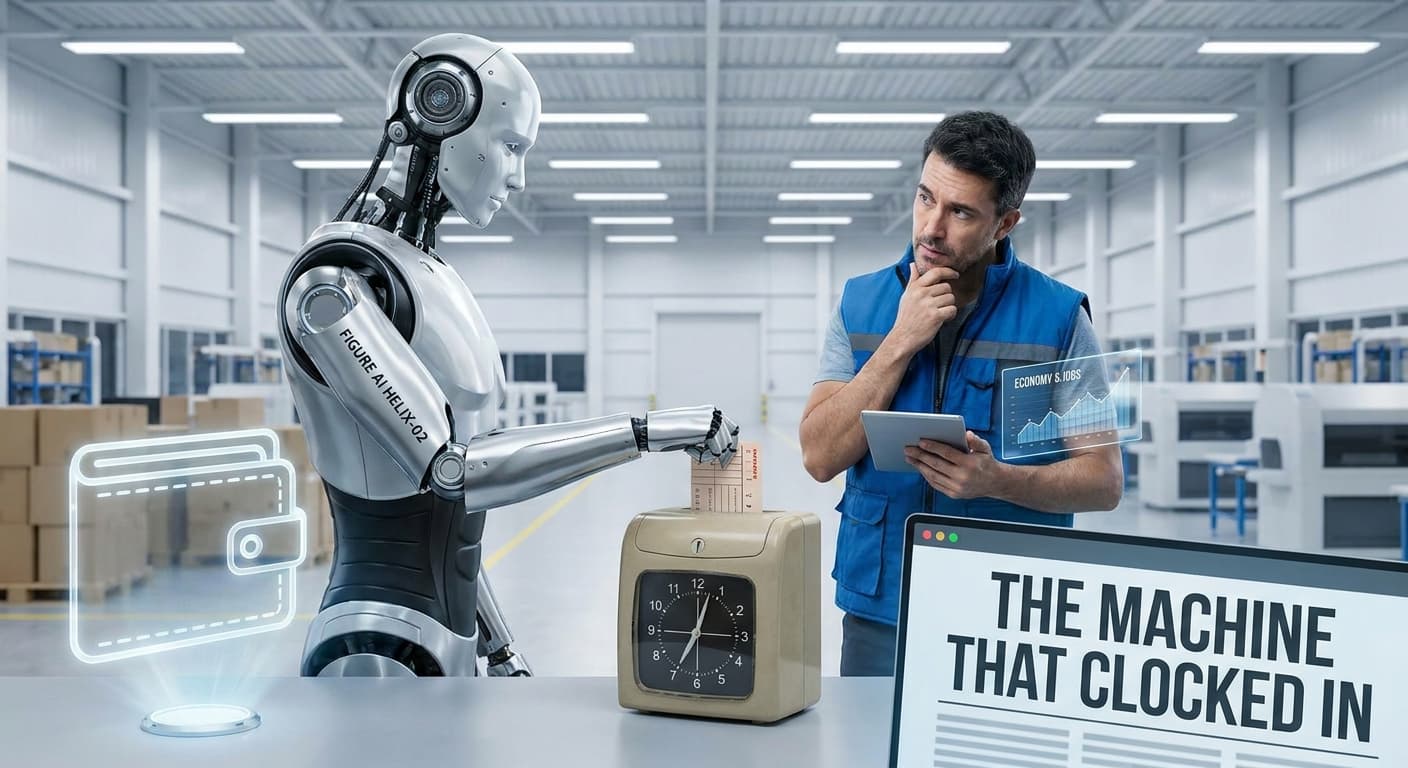
The Machine That Clocked In: What Figure AI's Helix-02 Means for Workers and Your Wallet
 Kazu
KazuOn May 13, 2026, Figure AI livestreamed something that would have read as science fiction five years ago: a team of humanoid robots completing a full, uninterrupted eight-hour warehouse shift, autonomously, without a single human intervention. The robots, powered by Helix-02, sorted and moved packages onto conveyor belts with the rhythm and endurance of a seasoned floor worker. No breaks. No fatigue. No paycheck.
The internet had a predictable reaction. Half the comments were awe. The other half were dread.
Helix-02 is a unified neural network that fuses vision, touch, proprioception, and whole-body control into a single system. It processes inputs from head cameras, palm cameras, and fingertip tactile sensors before translating them into coordinated movement across legs, torso, arms, wrists, and fingers. Figure AI replaced over 109,000 lines of hand-engineered code with a learned controller trained on more than 1,000 hours of human motion data. The result is a machine that moves like a person and thinks like software.
What follows is an honest accounting of what the technology delivers and what it costs, beyond the two obvious headlines.
The Negatives
Jobs on the Line
The packaging and fulfillment industry employs roughly 1.7 million Americans in direct assembly line, sortation, and warehouse roles. These are positions built around repetitive physical tasks that Helix-02 can now perform for eight continuous hours at human performance benchmarks.
The deployment history is already extensive:
- Figure AI at BMW (Spartanburg, SC): Figure 02 robots completed 10-hour shifts moving more than 90,000 parts tied to production of over 30,000 vehicles
- Amazon partnership: Valued at $675 million over three years, covering humanoid robot deployment across 10 fulfillment centers by end of 2026
- Tesla Optimus Gen 3: More than 1,000 units in active production facilities
- Toyota Canada: Signed with Agility Robotics for Digit humanoid deployments at its SUV manufacturing plant
- Siemens Germany: Autonomous tote-handling trial logged 60 moves per hour at 90-plus percent pick-and-place accuracy across a full eight-hour run
The jobs most immediately at risk:
- Sortation workers and package handlers
- Assembly line laborers in light manufacturing
- Pick-and-pack roles in e-commerce fulfillment
- Pallet builders and conveyor attendants
Automation does create new jobs in maintenance, robot training, and AI supervision. Those roles require credentials that a 52-year-old sortation worker in Memphis cannot acquire in a six-week retraining program. The new jobs cluster in engineering hubs. The displaced jobs are in zip codes that have already weathered the loss of manufacturing and retail employment over the past 30 years.
There is a second-order effect that receives less attention: wage compression in roles that survive. When employers can credibly threaten to replace a worker with a machine costing $25,000 to $100,000 upfront, bargaining power erodes. Even workers who keep their jobs may find their wages stagnating against a competitor that does not negotiate.
Concentration of Economic Power
The companies that can afford to deploy humanoid robots at scale are the same companies that already dominate their industries. Large-scale deployment requires capital, infrastructure, and the technical staff to integrate and maintain a robot fleet. That combination creates a compounding advantage:
- Amazon, Walmart, and a handful of third-party logistics giants will automate faster than regional or mid-sized operators
- Smaller competitors, unable to match the capital outlay, lose the cost advantage that scale already gave the majors
- The efficiency gains flow upward to shareholders in consolidated markets rather than spreading across a competitive field
Security, Liability, and Geopolitical Risk
A warehouse running a fleet of networked humanoid robots is a networked system, and networked systems have attack surfaces. The security implications of large-scale robot deployment remain largely unaddressed by both industry and regulators:
- Cybersecurity exposure: A compromised robot fleet could be used to halt operations, corrupt inventory data, or cause physical damage to goods and co-workers. Unlike a hacked database, a hacked robot has a body.
- Liability gaps: When a Helix-02 unit injures a human co-worker or destroys a shipment, existing tort law does not clearly assign responsibility between the robot manufacturer, the software vendor, the deploying company, and the facility operator. Courts and insurers are years behind the technology.
- Geopolitical dependency: Chinese manufacturers are winning the cost war. Unitree's R1 launched at $4,900. Mid-tier Chinese commercial units are available under $10,000. American logistics companies deploying cheap Chinese robotics are trading one supply chain dependency for another, this time with a direct line into the operational core of their facilities. The national security implications of foreign hardware running autonomously inside critical logistics infrastructure have received almost no public debate.
Skills Erosion and Environmental Cost
Two longer-horizon negatives rarely make the headlines.
The first is workforce skills erosion. Entire categories of manual dexterity, spatial problem-solving, and physical coordination that humans develop through repetitive work will atrophy across a generation if those tasks are fully automated. The workforce that emerges from a fully roboticized logistics sector will have fewer people who know how to do physical work at a high level, and no clear mechanism for rebuilding that capacity if automation fails or is disrupted.
The second is energy consumption. A 500-unit humanoid robot fleet running 24/7 across three shifts draws significant electrical load. The efficiency gains from eliminating human labor need to be weighed against the power footprint of continuous robotic operation at scale, particularly as grid strain and energy costs become more pressing. Current deployment models largely ignore this calculation.
The Positives
Lower Costs and Better Delivery Reliability
Labor is the largest single operating cost in warehouse and fulfillment, typically 50 to 65 percent of total logistics spend. A single humanoid robot unit now costs $10,000 to $25,000 annualized versus $35,000 to $55,000 in fully-loaded human labor costs, accounting for wages, benefits, turnover, training, and management overhead. Scale that across a 500-person fulfillment center and the potential annual savings run into the tens of millions.
The robot price curve is aggressive:
- Units sold for $85,000 in 2024 are now available under $25,000 from commercial suppliers
- Unitree's R1 launched at $4,900 for capable general-purpose movement
- Analysts project continued price compression through the decade
The more immediate consumer benefit is reliability. Humanoid robots:
- Do not call in sick or miss shifts
- Sustain consistent throughput during peak season without surge-wage premiums
- Do not slow down during the final stretch of a long shift
- Enable facilities to run three continuous shifts at flat cost rather than paying overnight and holiday premiums
Worker Safety and Injury Reduction
Warehousing and fulfillment rank among the most physically punishing sectors in the American economy. OSHA data puts the injury rate in warehousing at roughly 5 cases per 100 workers annually, driven by repetitive strain, heavy lifting, slip-and-fall incidents, and musculoskeletal damage accumulated over years of the same motions.
The tasks that Helix-02 performed in the livestream, picking and moving packages for eight continuous hours, are precisely the tasks that generate the most cumulative physical damage in human workers. Shifting those tasks to robots:
- Eliminates the primary driver of repetitive strain injuries in packaging roles
- Removes workers from environments with heavy machinery, conveyor systems, and vehicle traffic
- Reduces employer workers' compensation liability and the human cost of chronic physical injury
- Frees workers in remaining roles from the most physically degrading parts of the job
Supply Chain Resilience
COVID-19 exposed how fragile human-dependent supply chains are under stress. Labor shortages, absenteeism spikes, and facility shutdowns cascaded into stockouts, shipping delays, and price spikes across virtually every consumer category. A fulfillment infrastructure built on humanoid robots is structurally immune to most of those failure modes:
- Pandemic or health crisis: Robots do not get sick, cannot spread infection, and do not require PPE protocols or social distancing adjustments to the facility layout
- Labor market tightness: The chronic shortage of warehouse workers in rural logistics corridors, which drove wages up 30 to 40 percent between 2020 and 2024, becomes irrelevant when the workforce is robotic
- Demand spikes: A robot fleet scales throughput by adding units, not by recruiting, onboarding, and training workers on a six-week timeline during a holiday crunch
- Geographic flexibility: Facilities in regions with thin labor pools, which are often closer to distribution endpoints, become viable when the workforce does not need to commute
Domestic Manufacturing Competitiveness
For three decades, American manufacturers lost production to overseas labor because the cost gap was simply too wide to bridge. A garment sewn in Bangladesh or a consumer electronic assembled in Shenzhen reflected labor costs that no American wage floor could match.
Humanoid robotics changes that calculus in sectors where labor cost was the primary driver of offshoring:
- A robot deployed in Ohio costs the same to operate as one deployed in Vietnam or Mexico
- There is no labor arbitrage when the workforce does not have a nationality
- Domestic facilities benefit from proximity to consumers, lower shipping costs, faster iteration cycles, and reduced geopolitical exposure
What Comes Next
Helix-02 completing an eight-hour autonomous shift is the first data point in a deployment curve that will move faster than most labor market institutions are built to handle. The technology is no longer a forecast. The consequential choices now are policy ones: retraining infrastructure, portable benefits that survive job transitions, antitrust scrutiny of robotics-accelerated market consolidation, and an honest national conversation about the security implications of foreign hardware running autonomously inside American supply chains.
Helix-02 is an extraordinary machine. What happens next depends on choices that no robot can make.
Figure AI's Helix-02 system completed its first publicly documented full eight-hour autonomous shift during a livestreamed demonstration on May 13, 2026. The company is currently deployed at BMW, Amazon, and multiple undisclosed manufacturing partners.